High school cross-country team take shelter dogs out for a run. Read the story here, and watch the video the team's coach (and mastermind behind the whole idea) posted on Facebook.
Kudos, St. Joseph High School. Here's to more kids (and adults, and schools, and offices, and... well, people) following your example.
There are so many misconceptions about rescuing. So, so many...
The truth is that most people don't know what rescuing really is. Or what it takes. (Or what it gives.) And most rescuers rarely talk about it. After all, most of us prefer animals over people.
Every person, whether two- or four-legged, needs a home. But for four-legged ones, "home" is—quite literally—where the human is. And what if your human doesn't have a home of his/her own?
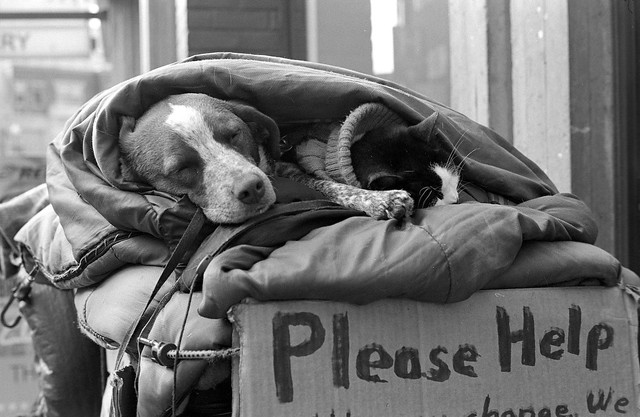
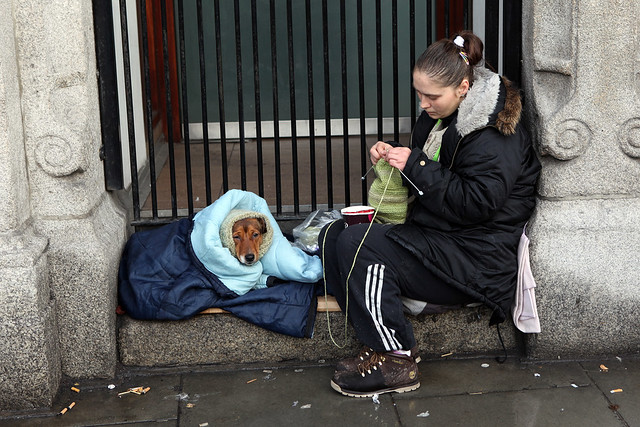
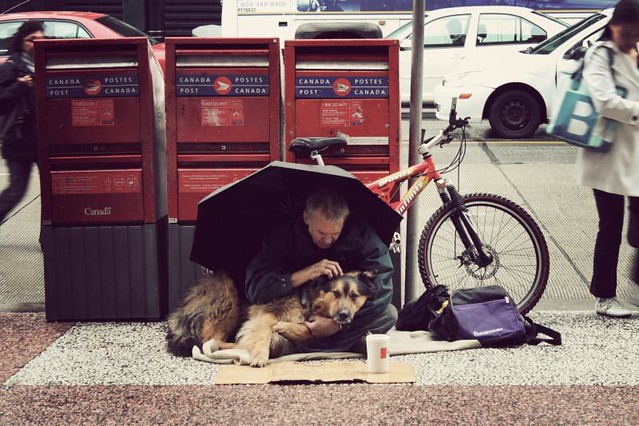
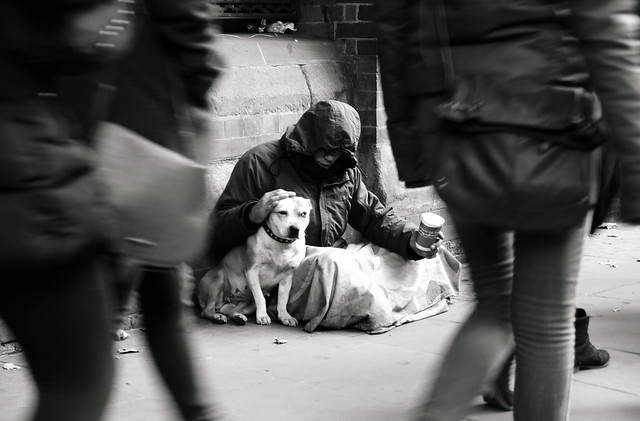
You see them often, everywhere. Homeless people with animals. What little they have, they share with that dog or cat (or bird, or...). Often they'll go without food themselves in order to feed their companion. It's not an ideal situation for either of them, but it still warms my heart to see it: these bonds of love between two homeless beings. How wonderful that hey've found each other. That generosity of spirit exists even in the most desperate of circumstances: in the human with nothing, in the animal who's been abandoned and mistreated and has no reason to trust a single human being ever again.
As generous as the homeless human may be, however—as willing as s/he may be to sacrifice him/herself in order to provide for the animal (who, by the way, is even more helpless than the human)—there are things that will be forever out of reach.
I can't imagine anything more desperate than seeing one of my dogs hurt or sick and not being able to take them to the vet. These dogs (and cats) of the homeless live on the streets; they're exposed not just to the elements but to human cruelty. They can be hit by a car. They can eat poisoned food. They can get kicked, or punched, or stabbed—and their human can do very little to protect them. Besides, they're not getting yearly vaccines. Or a balanced diet. Or tick- and flea-prevention tablets. Or deworming. Or HeartGard.
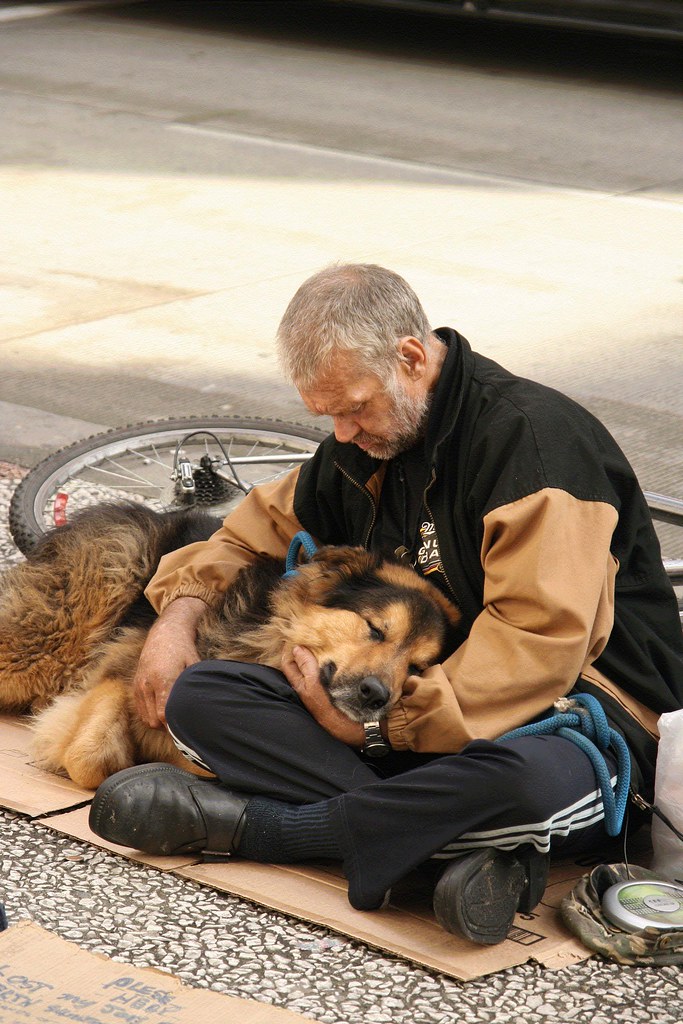
Look at this man. His face is full of love. He'd be heartbroken if something happened to his dog... Especially if it was something that could've been prevented with just a little bit of cash.
Pets of the Homeless is an organization that understands this and wants to help. They feed and provide emergency veterinary care for animals whose humans are homeless.
Yes, of course the ideal thing is to eliminate homelessness completely—for humans and animals. But that's not going to happen any time soon. Meanwhile, these pets need help that their humans—who love them as much as you love yours, if not even more—aren't, in spite of their most frantic efforts, able to provide.
P.S. — If you're as touched by this story as I was, maybe you want to help. You can donate ($50 will provide food and basic vet care for 20days!), or find other ways to participate. In the year-end spirit of giving, this seems like a beautiful way to make a difference.
In Sept 2012, a small female dog was rescued from a garbage dump on the west end of the island and we offered to foster her. She was about a year old, of the nicest temperament... even though life had thrown her its worst. Not only had she been dumped (thrown out like garbage... Really, who does that???) and had suffered hunger, but she also had tick fever (ehrlichiosis), a host of intestinal parasites, and she was heartworm-positive. A month later, we found out she was also pregnant—and, in spite of the high-risk birth due to the medication she'd been on, it was a higher risk to terminate the pregnancy. Romy—that's her name—gave birth to seven big, healthy puppies on the night of Nov. 4-5, 2012. All of them survived.
And now the challenge was to raise them properly—socialized, well-behaved, loving—so they could find excellent homes.
(You can check out the full story at Parts I and II.)
Nov 5th, 2:52 AM. Six newborn puppies.
(Unbeknownst to me, there was a seventh still to come.)
With a litter of seven pretty uniformly colored — and uniformly sized — puppies, it was hard to tell them apart.
Now, Romy's wasn't my first birth. I've seen my share. And usually, even with uniform coloring, you can keep track by how dry their fur is, or at the very least by size.
But this time, as soon as Puppy #2 came out, I was clueless. In the end, we had four black ones, three dark-brown, and among them the only ones I could identify were The Girl (only one female in the litter), and a black male who was born with a short tail. (I'd never seen that happen, by the way. I didn't even think it was possible.)
Nov. 11th, 2012
Romy handling motherhood like a boss.
Nap time!
(See the puppy with her head hanging out of the basket?
Yep. That's The Girl.)
Both of these, though — The Girl and Short-Tail — were black. Two other black ones, and all three brown ones, remained interchangeable for at least the first week. Maybe even the full ten days until they opened their eyes. They grew at the same rate, they seemed to have the same amount of energy, and exhibited the same apparent dominance in fighting for a teat or for the 'top of the pile' sleeping spot.
Except for The Girl; from the first, she was the Alpha of the litter, undisputed.
But going on a week later, it got easier to tell some of these babies apart. Mr. Short-Tail also had a white streak on his nose, and a thunderbolt down his chest. The Girl grew brown eyebrows and socks, kind of Rottweiler-ish. Of the brown batch, previously unidentifiable, one developed a white spot on a hind paw. Just the tip of the toes, like his foot had been dipped ever so daintily in white paint.
Remember this. It will change lives.
Sixteen days after they were born, we caught said white-paint-toe-dipped puppy on camera, exploring the world...
Not long after, the den had become too small for them. I started bringing them out to the patio for an hour or two at a time.
The first patio incursion, Dec 2, 2012.
The puppies were 3 days short of a month old.
And, because they were so big—and growing bigger by the day, almost by the hour—and because Momma Romy was so small and so skinny, we started giving them puppy formula to 1) supplement their nourishment and 2) begin the weaning process.
Dec. 4, 2012 "What's this? Milk not in a boob?"
You can see how quickly they took to the formula. And you can tell they were no longer unidentifiable. Our once-interchangeable puppies were becoming little individuals... And it was time to give them names.
The first one, perhaps the easiest one, was The Girl. From very early on, I started calling her Nena, which is "baby girl" in Spanish. (So sue me for lack of creativity.)
Meet Nena (aka The Girl). Looks like a little Rottweiler, doesn't she?
Dec 12, 2012
Another easy one was Bunny—Mr. Short-Tail with the white streaks on nose and chest.
Bunny, Dec 12, 2012
The others took a bit more thinking, but eventually I came up with names:
Sam
(Dec 12, 2012)
Zorro
(Dec 11, 2012)
Two of the brown puppies were getting lighter, and seemed to have shorter, less furry hair than the others. And, dammit, they looked like twins. I named them, but for another month or so, I wouldn't be able able to tell them apart unless I had them both in front of me. Look at them:
The twins, Benny and Dennis, Dec 12, 2012
There was another pair of quasi-twins, but I never had any trouble telling those two apart. You see, one of them was that wandering puppy, the one with the white-paint-dipped toe (although, by then, a few others had developed white toes). And I was smitten.
Duncan
(Dec 12, 2012)
Duncan and Sam were very, very close in coloring. In the photos above, the one on the upper right has Duncan sleeping in the foreground and Sam behind him. You can see the similarities... But Duncan was lighter than Sam. And, besides the white-tipped right hind toe (you can see it in the bottom right photo, if you look closely), Duncan also had that white star on his chest. And a white-tipped chin. And... I don't know, we had a bond. From the day he could see me and interact with me, something passed between us. He was my dog, and I was his human. Period.
Sam (left) and Duncan (right), playing in the patio.
Dec 12, 2012
Except, of course, we already had more dogs than we ever expected, or could handle. Aside from our own canines (Panchita, Rusty, Sasha, and Winter), in Dec 2012 we were fostering another dog, Blondie, who wouldn't get adopted any time soon (she'll get her own post soon and I'll explain)... And five dogs were already way, way far beyond the limit of 3 we'd agreed on as a family.
So I said nothing about Duncan. I kept this thing between us to myself. I thought, life will sort it out. Maybe when we got adoption applications, the perfect family would come up. Maybe this attachment I felt was just puppy love (literally), and I'd grow out of it. Maybe... Or maybe not.
So some seven weeks ago, I got a desperate call mid morning: someone had found a box of puppies, less than ten days old (their eyes were still closed) in the street. Seven puppies. Who needed to be bottle-fed. Who would, most probably, die anyway. But an animal rescuer that gives up before giving it not just the best but everything is not an animal rescuer at all.
So I took them in. Just for a week, they told me. Another volunteer, with better facilities (remember some members of my seven-pack aren't exactly friendly, and I had no idea how they'd react to puppies, of all things), would take them in the following weekend.
Okay. A week is doable.
They arrived in a donated cat carrier, all seven of them, asleep and twisted around each other like snakes. I took out the one closest to the front and held him in my hand, and my heart sank. These puppies were newborns. Two days old, three tops.
I prepared myself for heartbreak, sooner or later. Probably sooner. Then I prepared a batch of milk substitute, also brought by the volunteer. Each can costs Naf. 50 (about USD 30); raising orphaned puppies has become a luxury.
I can't understand how it's possible, full into the 21st century, that we haven't come up with a better solution for feeding infant animals. Let me tell you: bottles do not work. They hate them. It feels artificial; there's nothing, let alone flesh, surrounding the nipple for their little paws to press against; there's no warmth, no furriness. And there's air going through along with the milk, which is, of course, Not Good.
Seriously. To any inventors out there, I'm begging: please--please--come up with something better.
One puppy did die, the day after I got them. He probably (we weren't going to do an autopsy on a tiny days-old body) aspirated some milk into his lungs, which caused inflammation and infection, and he asphyxiated. He died literally a minute before the vet got to him. Not that the vet could've done anything. No one could. (I keep telling myself that. Doesn't seem to work.)
That first week was hard. I camped out on the sofa, the puppies in a laundry hamper next to me. I slept when they slept, which wasn't all that much. I brought out the bottle as soon as I heard the first whimper. At that age, they need food (and liquids) every two hours, but they didn't like the bottle, so they drank very little. Slowly they began to understand that that ugly plastic thing that tasted funny was, strangely, where the food came from. Slowly they began to drink more, faster.
I ended up keeping three--fosters, not permanent additions to the family... at least not yet. Another foster took the other three. A load shared is a load halved, right?
Ochoa (black) and Snijder, 4 weeks, discovering
the pleasure of sticks--and of fighting over them.
When one began to open his eyes, we were able to calculate exact date of birth (count back ten days, presto): June 18th. We called them the WK pups (WK being the Dutch abbreviation for World Cup). And since they came to me the week before the NL-MX game, we named the three brown ones after Dutch players--Persie, Snijder, and Fer--and the black ones after Mexican players: Ochoa, the biggest one (seriously, he's double the size of his siblings), Rafa (for Rafa Marquez), and--oops, the third one was a girl. We tried several variations, but ended up with Nena (baby girl in Spanish). Her future mom is going to call her Nona.
The tiny one that died was Chicharito.
This past Wednesday they turned 7 weeks old. The week before, at 6 weeks, they got their first vaccination--and just in time, because a parvo epidemic has hit the island. May and June produced a record number of abandoned puppies, and most of the little ones are sick now. Several have died--including, today, one of the WK family, Persie.
Beautiful, smart Persie. Run free, little one.
I'm heartbroken. He didn't live with us for more than a week, but it was an intense week. He was the one that least liked the bottle (opposed to Ochoa, for instance, who got over the plastic discomfort pretty fast once he figured out there was food at the other end), so I spent a lot of time with him on my lap. My chest. My arms. He was the first one to open his eyes. The first to crawl out of the basket. The first to walk. He was so, so smart, and he would've been a fantastic adult dog. The world has been cheated out of a canine jewel.
I know I've been neglecting you. And I'm sorry. I'm sorry, too, for ending on such a sad note. It's a sad day. On the other hand, none of them had halfway good chances of making it, and here they are, five of them, alive and healthy and strong--and four are going to fantastic homes. The fifth one will find his "golden basket", as they say in Dutch; it's just going to take a bit longer. Which means we get to enjoy him all the more.
Oh yeah, cutie. You get to stay in this pack a bit longer.
Six PM. Usual feeding time. Nassau--so named because that empty lot where she lived, if living it can be called, is on the way to Fort Nassau--came out as soon as she heard my car, approached me as fearlessly as the day before.
Wish I could say the same for me.
Fear makes us tentative, hesitant. Fear stinks of adrenaline, the scent-tag of aggression. I had to get rid of the stink, or I'd get bitten again. Worse, I'd never get Nassau in the car.
Nassau was the beginning of my formal training in dog behavior. I didn't even believe in dog trainers. In my mind, they were all nasty control freaks that used dogs as an outlet for their inferiority complexes, forced them to perform circus tricks for human entertainment. Punishment. Whips.
I had a lot to learn. And Nassau didn't waste time teaching me.
The last weekend of September [2012] I got a call from CARF. "There's a dog at the dump," the woman said. "We've been feeding her for a while, and we think she's ready to be caught and brought to the vet. Can you foster her?"
Romy, at the dump, the day
before she was rescued.
Uh, yeah. But--at the dump? The garbage dump? They threw her away like garbage?
"The rescuer will meet you at the vet's Monday morning."
The rescuer called me Sunday evening, a lovely Dutch woman, wife of a Marine officer, unfortunately only stationed here in Curaçao for a few more years. Why can't people like these stay around forever?
When I walked into the vet's waiting room, she was holding a reddish-yellow dog, smaller than I thought, on her lap. Huge eyes, all sweetness. Her legs were stiff from fear, but she let herself be moved over to my lap and we cuddled while we waited. She was so dirty--he-llo, garbage dump--that I got a rash all over my arms and neck. Nothing that a good shower didn't cure, though.
I'm a Valentine grinch. It's pre-fab and commercial, and it turns peer pressure up sky-high. If you're with someone, V-Day turns a relationship into a checklist that grows longer--and more unsatisfying--with every other couple you see. Is my partner good-looking enough? Are we, as a couple, romantic enough? Did I get flowers? A card? Handwritten? Did I get jewelry? Was it the real stuff?
If you're single, the twenty-four hours of February 14th are proof time is relative. No day lasts longer.
There's someone, though, who would--quite literally--die for a little of that love consumerism's trying to convince us to show via Visa or Mastercard. This someone doesn't need a box of chocolates (that would actually be a bad idea), wouldn't know what to do with a dozen red roses (but the box might be interesting), and couldn't care less about diamond-studded accessories. What s/he wants, more than anything, is your time. A half hour of your day will make her/his life, which is doomed to be short, not just bearable but purposeful.
Visit your local shelter. Spend a little time cuddling an abandoned dog or cat today. They might never know what a friendly human hand is without you.
Take your partner, take your friends, go alone. Celebrate this Valentine's with the only beings on the planet that understand unconditional love. Make this V-Day what it's meant to be about: giving, receiving, and spreading love.




.jpg)
