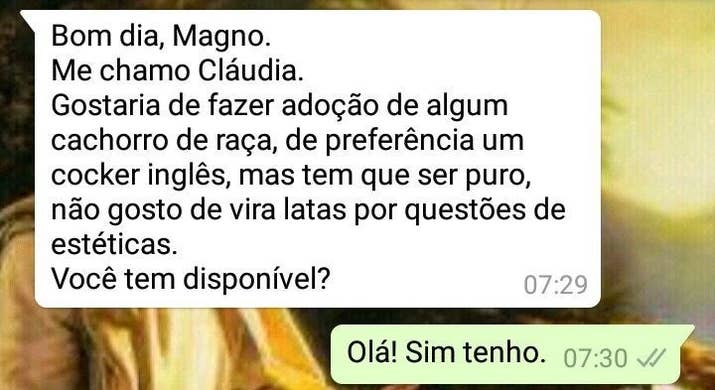
A friend just posted this article on Facebook, and I had to share. All rescuers are intimately familiar, unfortunately, with those racist bigots who only want to have 'purebred' dogs—yes, racist bigots; what else would you call someone who exhibits overt and shameless prejudice towards race, country of origin, or ancestry?
So... this happened in Brazil. One of these racist bigots was interested in adopting a dog—but it had to be a purebred, "preferably an English Cocker [Spaniel]", because she didn't like "vira latas" ('mutts') due to "aesthetic reasons".
(The story is in Portuguese, but I've translated, loosely, the gist here.)
Magno's response, in green: "Hi! Yes, I do have one available."
Racist bigot Claudia, probably feeling all warm and fuzzy at the prospect of soon having her purebred puppy at home, goes on to ask what the adoption requirements are.
The name his rescuer gave him was Everest, because she found him in Montaña, a neighborhood in here in Curaçao, which translates to "Mountain"... Personally, I might have gone with Kilimanjaro, or even Blanc (you know, for Mont), but—well, naming is the rescuer's prerogative. Either way, this first name wasn't going to last, because a couple of months later, when a fabulous woman adopted him—only temporarily, as it turned out, but I'm getting ahead of myself here—she decided that, him being a (sort of) Chihuahua and all, he needed a more Mexican name. One of the most common appellatives in Mexico is Jesús (pronounced heh-SOOS), and every Jesús I know gets called, for unfathomable reasons, Chucho for short.
So Everest became Chucho.
Chucho (even before being called Everest) came to us on October 5th, 2016, and it was thanks to Facebook. I belong to several animal rescue groups (surprise, surprise), and on this particular fine afternoon a post popped up on my timeline from a fellow member asking for advice. She'd found this tiny dog on the side of the road, walking in tight, tight circles and acting disoriented. She didn't know what to do. I was probably the third person to reply, and echoed exactly what the other two people had said: Take him to the vet. ASAP. And I added that I'd be happy to do it myself, if she wanted. People not intimately familiar with rescue have no way of gauging what the veterinary 'damage' will be, so sometimes they hesitate to take an animal to the vet out of fear they won't be able to afford the bill. Plus, not everyone can drop their lives at a moment's notice in order to rush a strange dog to the ER. In this particular case, the rescuer said in her post that she knew next to nothing about dogs, that she'd always been more of a cat person; I felt she had done enough by picking up the dog to begin with, so it seemed only reasonable to step in and offer help.
At the home of his rescuer while they waited for me. All he wanted was to sleep. No water, no food, just... sleep. Yep, not a good sign.
I arrived at her door about a half hour later, after a few wrong turns but not nearly as many as I expected; it was Election Day here, and a voting location had been set up just a block from her house, so the crowd and the lines of parked cars were hard to miss. She helped me load the dog—who really was tiny; he'd looked rather larger in the photo she posted—into the car, and I promised to call as soon as I had some sort of diagnostic. I did warn her that, from the behavior she'd described—the walking in circles, the disorientation, the lack of appetite or energy—the prognosis would probably not be very good. "There's a chance he'll need to be put down," I told her, as kindly as I could. She nodded, reached a hand in through the open window to pet the tiny head again. "I understand."
Lynne Hinkey is a marine scientist by training, a writer by passion, and a curmudgeon by nature. An Olympic-caliber procrastinator, she honed her skill through years of practice and dedication to life on island-time. She uses her experiences living in the Caribbean to infuse her novels with tropical magic, from the siren call of the islands to the terror and hysteria caused by the mysterious chupacabra.
It all started when cancer took our beloved Murphy from us in February. He wasn't quite 11 years old.
Murphy & me
We'd had three months of warning that this was coming. In November, he had collapsed. I was the only one home. I scooped him up and drove like a lunatic to the vet. The vet did a sonogram and showed me the unmistakable outline of the large tumor on his spleen. He could probably save him this time, the vet told me, but it would only be a matter of weeks or months until the tumor ruptured and no one would be able to save him. Every day from here on in would be a gift.
The vet did save him that time, and then performed the same miracle once again in December. But in January Murphy began steadily losing weight and becoming weaker, despite his six daily medications. When he collapsed again on February 6th, we knew it was the end. Despite all the time we'd had to prepare, once he was gone no one in my family could imagine what we would do without him.
But we still had another dog at home that we had to take care of: 8-year-old Finney, our younger Goldendoodle, who from the age of 8 weeks had never known life without Murphy. And, unlike us, he didn't understand what had happened.
So… After fourteen posts (fourteen! we made it past the halfway mark, people!) you’ve decided that rescuing isn’t for you—but you still want to help. Here’s a list of ways—spanning from the creative to the simplest to the budget-friendly (and even the no-budget)—to help you help them.
Because of that space challenge we were talking about yesterday (over-capacity shelters, too few foster homes), rescuers all too often end up bringing a dog home. If you have no dogs, great; but what if, like most of us, you already have a houseful? Will they be okay with this new (temporary, or pseudo-temporary) member of the family?
People often think a rescued dog will be more “grateful”, and therefore more loyal, than other dogs. While that may sometimes appear to be true, in my (totally biased and uneducated) opinion it has more to do with the dog’s character than with the fact s/he was rescued. If a dog's gratitude is your reason for getting involved in rescue, consider this your fair warning.
Most rescued dogs adapt back into sharing their lives with humans pretty fast. The bond between us and dogs goes back a long, long way; it’s in their genes to love us, and to put up with our cluelessness. Even dogs who have been abused will respond favorably when re-homed.
As an animal rescuer and volunteer with animal welfare organizations, I'm no stranger to the cruelty humans inflict. Like one of the Animals Asia staff says in the video, it's stuff you never get used to—you just learn to put your emotions on hold in order to get the job done.
But this one... This one made me cry. For the puppy's pain, first, and then for his amazing recovery. And, especially, for his capacity for joy.
Miracles do happen. But only if you make them happen. Please donate / foster / volunteer at your local shelter or rescue organization before the end of the year. Remember these homeless and abandoned, and often mistreated, little ones when you're doing your holiday shopping... A little goes a long way for them. And no one will be more grateful.
In Sept 2012, a small female dog was rescued from a garbage dump on the west end of the island and we offered to foster her. She was about a year old, of the nicest temperament... even though life had thrown her its worst. Not only had she been dumped (thrown out like garbage... Really, who does that???) and had suffered hunger, but she also had tick fever (ehrlichiosis), a host of intestinal parasites, and she was heartworm-positive. A month later, we found out she was also pregnant—and, in spite of the high-risk birth due to the medication she'd been on, it was a higher risk to terminate the pregnancy. Romy—that's her name—gave birth to seven big, healthy puppies on the night of Nov. 4-5, 2012. All of them survived.
And now the challenge was to raise them properly—socialized, well-behaved, loving—so they could find excellent homes.
(You can check out the full story at Parts I and II.)
Nov 5th, 2:52 AM. Six newborn puppies.
(Unbeknownst to me, there was a seventh still to come.)
With a litter of seven pretty uniformly colored — and uniformly sized — puppies, it was hard to tell them apart.
Now, Romy's wasn't my first birth. I've seen my share. And usually, even with uniform coloring, you can keep track by how dry their fur is, or at the very least by size.
But this time, as soon as Puppy #2 came out, I was clueless. In the end, we had four black ones, three dark-brown, and among them the only ones I could identify were The Girl (only one female in the litter), and a black male who was born with a short tail. (I'd never seen that happen, by the way. I didn't even think it was possible.)
Nov. 11th, 2012
Romy handling motherhood like a boss.
Nap time!
(See the puppy with her head hanging out of the basket?
Yep. That's The Girl.)
Both of these, though — The Girl and Short-Tail — were black. Two other black ones, and all three brown ones, remained interchangeable for at least the first week. Maybe even the full ten days until they opened their eyes. They grew at the same rate, they seemed to have the same amount of energy, and exhibited the same apparent dominance in fighting for a teat or for the 'top of the pile' sleeping spot.
Except for The Girl; from the first, she was the Alpha of the litter, undisputed.
But going on a week later, it got easier to tell some of these babies apart. Mr. Short-Tail also had a white streak on his nose, and a thunderbolt down his chest. The Girl grew brown eyebrows and socks, kind of Rottweiler-ish. Of the brown batch, previously unidentifiable, one developed a white spot on a hind paw. Just the tip of the toes, like his foot had been dipped ever so daintily in white paint.
Remember this. It will change lives.
Sixteen days after they were born, we caught said white-paint-toe-dipped puppy on camera, exploring the world...
Not long after, the den had become too small for them. I started bringing them out to the patio for an hour or two at a time.
The first patio incursion, Dec 2, 2012.
The puppies were 3 days short of a month old.
And, because they were so big—and growing bigger by the day, almost by the hour—and because Momma Romy was so small and so skinny, we started giving them puppy formula to 1) supplement their nourishment and 2) begin the weaning process.
Dec. 4, 2012 "What's this? Milk not in a boob?"
You can see how quickly they took to the formula. And you can tell they were no longer unidentifiable. Our once-interchangeable puppies were becoming little individuals... And it was time to give them names.
The first one, perhaps the easiest one, was The Girl. From very early on, I started calling her Nena, which is "baby girl" in Spanish. (So sue me for lack of creativity.)
Meet Nena (aka The Girl). Looks like a little Rottweiler, doesn't she?
Dec 12, 2012
Another easy one was Bunny—Mr. Short-Tail with the white streaks on nose and chest.
Bunny, Dec 12, 2012
The others took a bit more thinking, but eventually I came up with names:
Sam
(Dec 12, 2012)
Zorro
(Dec 11, 2012)
Two of the brown puppies were getting lighter, and seemed to have shorter, less furry hair than the others. And, dammit, they looked like twins. I named them, but for another month or so, I wouldn't be able able to tell them apart unless I had them both in front of me. Look at them:
The twins, Benny and Dennis, Dec 12, 2012
There was another pair of quasi-twins, but I never had any trouble telling those two apart. You see, one of them was that wandering puppy, the one with the white-paint-dipped toe (although, by then, a few others had developed white toes). And I was smitten.
Duncan
(Dec 12, 2012)
Duncan and Sam were very, very close in coloring. In the photos above, the one on the upper right has Duncan sleeping in the foreground and Sam behind him. You can see the similarities... But Duncan was lighter than Sam. And, besides the white-tipped right hind toe (you can see it in the bottom right photo, if you look closely), Duncan also had that white star on his chest. And a white-tipped chin. And... I don't know, we had a bond. From the day he could see me and interact with me, something passed between us. He was my dog, and I was his human. Period.
Sam (left) and Duncan (right), playing in the patio.
Dec 12, 2012
Except, of course, we already had more dogs than we ever expected, or could handle. Aside from our own canines (Panchita, Rusty, Sasha, and Winter), in Dec 2012 we were fostering another dog, Blondie, who wouldn't get adopted any time soon (she'll get her own post soon and I'll explain)... And five dogs were already way, way far beyond the limit of 3 we'd agreed on as a family.
So I said nothing about Duncan. I kept this thing between us to myself. I thought, life will sort it out. Maybe when we got adoption applications, the perfect family would come up. Maybe this attachment I felt was just puppy love (literally), and I'd grow out of it. Maybe... Or maybe not.
So. The puppies have left, all three to extraordinary homes.
Nena, the only girl, left on Friday August 22nd. Ochoa left the next day, Saturday August 23rd. Little Sneijder, whose plans for adoption had fallen through, found the absolute most perfect home for him.
Cor saying goodbye to
Sneijder just before we
brought him to
his new home.
We walked him over--it's only a block away from us (!!)--the weekend before I left for Mexico.
So some seven weeks ago, I got a desperate call mid morning: someone had found a box of puppies, less than ten days old (their eyes were still closed) in the street. Seven puppies. Who needed to be bottle-fed. Who would, most probably, die anyway. But an animal rescuer that gives up before giving it not just the best but everything is not an animal rescuer at all.
So I took them in. Just for a week, they told me. Another volunteer, with better facilities (remember some members of my seven-pack aren't exactly friendly, and I had no idea how they'd react to puppies, of all things), would take them in the following weekend.
Okay. A week is doable.
They arrived in a donated cat carrier, all seven of them, asleep and twisted around each other like snakes. I took out the one closest to the front and held him in my hand, and my heart sank. These puppies were newborns. Two days old, three tops.
I prepared myself for heartbreak, sooner or later. Probably sooner. Then I prepared a batch of milk substitute, also brought by the volunteer. Each can costs Naf. 50 (about USD 30); raising orphaned puppies has become a luxury.
I can't understand how it's possible, full into the 21st century, that we haven't come up with a better solution for feeding infant animals. Let me tell you: bottles do not work. They hate them. It feels artificial; there's nothing, let alone flesh, surrounding the nipple for their little paws to press against; there's no warmth, no furriness. And there's air going through along with the milk, which is, of course, Not Good.
Seriously. To any inventors out there, I'm begging: please--please--come up with something better.
One puppy did die, the day after I got them. He probably (we weren't going to do an autopsy on a tiny days-old body) aspirated some milk into his lungs, which caused inflammation and infection, and he asphyxiated. He died literally a minute before the vet got to him. Not that the vet could've done anything. No one could. (I keep telling myself that. Doesn't seem to work.)
That first week was hard. I camped out on the sofa, the puppies in a laundry hamper next to me. I slept when they slept, which wasn't all that much. I brought out the bottle as soon as I heard the first whimper. At that age, they need food (and liquids) every two hours, but they didn't like the bottle, so they drank very little. Slowly they began to understand that that ugly plastic thing that tasted funny was, strangely, where the food came from. Slowly they began to drink more, faster.
I ended up keeping three--fosters, not permanent additions to the family... at least not yet. Another foster took the other three. A load shared is a load halved, right?
Ochoa (black) and Snijder, 4 weeks, discovering
the pleasure of sticks--and of fighting over them.
When one began to open his eyes, we were able to calculate exact date of birth (count back ten days, presto): June 18th. We called them the WK pups (WK being the Dutch abbreviation for World Cup). And since they came to me the week before the NL-MX game, we named the three brown ones after Dutch players--Persie, Snijder, and Fer--and the black ones after Mexican players: Ochoa, the biggest one (seriously, he's double the size of his siblings), Rafa (for Rafa Marquez), and--oops, the third one was a girl. We tried several variations, but ended up with Nena (baby girl in Spanish). Her future mom is going to call her Nona.
The tiny one that died was Chicharito.
This past Wednesday they turned 7 weeks old. The week before, at 6 weeks, they got their first vaccination--and just in time, because a parvo epidemic has hit the island. May and June produced a record number of abandoned puppies, and most of the little ones are sick now. Several have died--including, today, one of the WK family, Persie.
Beautiful, smart Persie. Run free, little one.
I'm heartbroken. He didn't live with us for more than a week, but it was an intense week. He was the one that least liked the bottle (opposed to Ochoa, for instance, who got over the plastic discomfort pretty fast once he figured out there was food at the other end), so I spent a lot of time with him on my lap. My chest. My arms. He was the first one to open his eyes. The first to crawl out of the basket. The first to walk. He was so, so smart, and he would've been a fantastic adult dog. The world has been cheated out of a canine jewel.
I know I've been neglecting you. And I'm sorry. I'm sorry, too, for ending on such a sad note. It's a sad day. On the other hand, none of them had halfway good chances of making it, and here they are, five of them, alive and healthy and strong--and four are going to fantastic homes. The fifth one will find his "golden basket", as they say in Dutch; it's just going to take a bit longer. Which means we get to enjoy him all the more.
Oh yeah, cutie. You get to stay in this pack a bit longer.
After yesterday's post, you probably think I'm partial to puppies. Who wouldn't be? Little bundles of cuteness overload, a pristine mind, character yet unshaped. Puppies--like the bunnies and chicks that symbolize Easter--offer a fresh start. A blank page. Holding a puppy in your arms is like holding the future. And our dreams for it.
It's no surprise that puppies get adopted a lot faster than adult dogs. Which presents a problem for rescue organizations.
Two, actually.
The first, most obvious, is that adult dogs have ever-narrowing chances of finding a good home. By "adult" I don't mean "senior"--even one- or two-year-old dogs get passed over for puppies. And every time that happens is another nail in their coffins. (If only they had coffins.)
The second problem is, actually, the core problem of dog rescuing. Where do all these homeless dogs come from? Sure, a lot are born homeless (especially in third-world locations like the Caribbean and Latin America)--but not all of them. A huge number started out life in homes, in families--a family that wanted that "bundle of cuteness overload", that "fresh start". But puppies don't stay puppies forever. They grow. Oh, so very, very fast.
Raising a puppy is every bit as challenging as raising a child. With one significant difference: you've got around six to eight years, depending on the branch of child psychology you prefer, to form that child's foundation of values and principles. With a puppy, you've got months. And not that many.
I get it; all you want to do with a puppy is cuddle and take pictures. What do you do when you find him cutting his tiny baby teeth on your Gucci loafers? You go Awwww, snap a photo, post it on Facebook, and all your friends go Awwwww too. And how can you possibly leave that itty-bitty baby in a crate all night? No, no; he sleeps in the bed with us. Plenty of time to teach him later.
Too many people fall in love with the baby cuteness and forget its days are numbered--until, one day, the puppy is no longer a puppy, it's a grown dog that growls at you when you try to get him off the bed. Off goes the ex-puppy to the shelter (or the street).
Raising a puppy to be a calm, independent, happy adult--the companion of your dreams--is hard work.
An adult dog comes with challenges, too, but they're of a different nature. They're already there, immediately visible so you can decide whether you can or cannot deal with them.
An adult's basic character traits--full of energy or mellow, social or not, a cuddler or a loner--have already been established and (unless you're into rehabilitation, which is a whole different ballgame), won't change.
An adult is much easier to train; they've lived enough to know, for example, that going potty in the same place where you sleep or eat is a bad idea. They test boundaries less. They love with less distraction, less challenge.
And yet ninety percent of people will stride past the adult cages at a shelter without so much as a second glance.
Why is it that we value youth so much more? Not just a dog's--ours, too. The golden years were in our teens, our twenties. Growing old seems like the end of everything, a tragedy that most people go to extreme lengths to postpone--as if it could be. Lying about their age; using all sorts of creams, make-up, concealers, magic potions. Studying pop culture to be in with the newest slang, the latest fashions, the hippest music. Going under the knife.
Why? Why is the passing of time so dreaded? Isn't it through this very passing that we acquire experience? Why is being older so bad?
Older dogs may not have the effervescence of puppies--thank heavens--but they have plenty of energy to keep any human company in the exercise department. Older dogs don't have to chew on everything to figure out what they like; they already know what tastes good, what doesn't get them into trouble--and they can spend more time chewing that.
Relationships with older dogs are more fulfilling--more time spent in quiet contemplation rather than in a tug-of-war to establish who's who. Power struggles and pissing contests aren't necessary.
I think that's also true of our own relationships as we get older.
~ * ~
Thank you for visiting, for all your awesome comments, and for helping make Life In Dogs's
How did we miss Romy's pregnancy? Easy: she was probably three days pregnant when we picked her up. All initial vet checks showed no signs because it was too early. And canine pregnancies go fast--before you know it, it's too late to do anything about it.
Romy at the vet on Oct 15 (2012)
Three weeks before giving birth. Looks very
un-pregnant, doesn't she?
Which is exactly what happened.
So Romy was going to have puppies. A problem in itself: in an island where homeless dogs are too many to count, where animal rights culture is a step up from non-existent, finding good homes, even for puppies--perhaps especially for puppies, because everyone wants them while they're young and adorable, not so much later when the cuteness is marred by their potential for destruction--is not an easy thing.
There was another problem, however. A more immediate problem. Romy's foster had upwards of 17 dogs. Romy would have to give birth in close proximity to them. Even separated by the iron fencing of the kennels, everyone could see this wasn't a good idea.*
I'm a Valentine grinch. It's pre-fab and commercial, and it turns peer pressure up sky-high. If you're with someone, V-Day turns a relationship into a checklist that grows longer--and more unsatisfying--with every other couple you see. Is my partner good-looking enough? Are we, as a couple, romantic enough? Did I get flowers? A card? Handwritten? Did I get jewelry? Was it the real stuff?
If you're single, the twenty-four hours of February 14th are proof time is relative. No day lasts longer.
There's someone, though, who would--quite literally--die for a little of that love consumerism's trying to convince us to show via Visa or Mastercard. This someone doesn't need a box of chocolates (that would actually be a bad idea), wouldn't know what to do with a dozen red roses (but the box might be interesting), and couldn't care less about diamond-studded accessories. What s/he wants, more than anything, is your time. A half hour of your day will make her/his life, which is doomed to be short, not just bearable but purposeful.
Visit your local shelter. Spend a little time cuddling an abandoned dog or cat today. They might never know what a friendly human hand is without you.
Take your partner, take your friends, go alone. Celebrate this Valentine's with the only beings on the planet that understand unconditional love. Make this V-Day what it's meant to be about: giving, receiving, and spreading love.